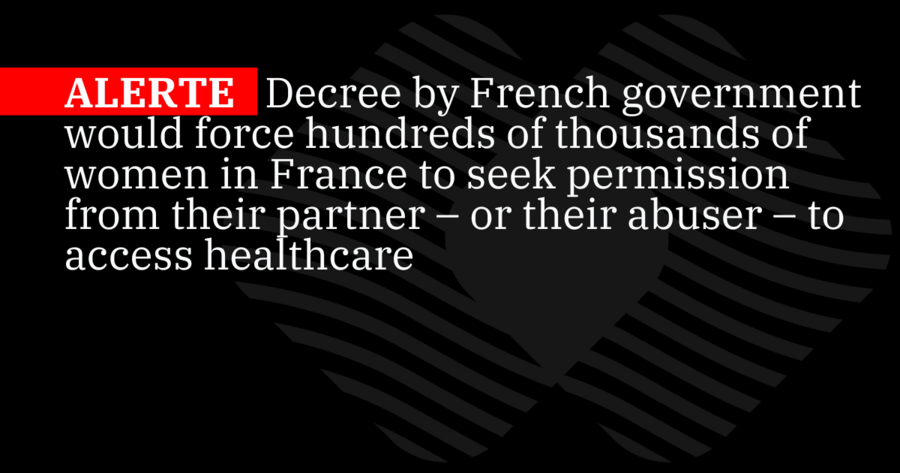
Women for Women France (WFWF) has obtained a copy of two draft decrees transmitted yesterday by the government to the Caisse Nationale de l’Assurance Maladie (CNAM), aimed at restricting access to State Medical Aid (AME).
We can confirm that Article 2 of the draft decree proposes to amend Article 40 of Decree no. 54-883 of 2 September 1954 in order to take the partner’s income into account when calculating eligibility for AME:
“The resources taken into account for admission to State Medical Aid, under the first paragraph of Article L. 251-1 of the Code of Social Action and Families, consist of the applicant’s resources and those of the persons referred to in 1° and 2° of the same article, as defined in the second paragraph of this article. The resources of the insured spouse, cohabiting partner, or civil partner will therefore be taken into account in determining eligibility for AME.”
Without the right to work, without access to Social Security, and having lost dependent status since the 2016 “PUMA” law, AME is currently the only scheme that allows undocumented women to access essential healthcare in France: contraception, treatment for diabetes, care related to sexually transmitted infections, pregnancy monitoring, cancer treatment, and more.
Women for Women France stresses that the majority of these women are “undocumented” not by choice, but because they have lost their residence permit due to failures in the French administrative system, as documented by the Défenseur des droits in 2024, or because their partner has deliberately placed them in an irregular situation (confiscation of identity papers, blocking access to online procedures, etc.). This form of domestic abuse is not yet recognised under French law.
The consequences of taking the partner’s income into account will be catastrophic
1. Women will be forced to ask their partner for permission to access healthcare
If the 100,000 women concerned lose access to AME, they will no longer have any independent right to healthcare. Their partner’s income, combined with their own (if any), will push them above the threshold.
They would therefore be forced to ask their partner for money, and in reality, for permission, to access medical care.
“No woman should ever have to ask her partner for money and therefore, in reality, for permission to see a doctor. This must be an absolute red line in any reform of AME.” deplores Sarah McGrath, Chief Executive Officer of Women for Women France
2. Women will be forced to ask their abuser or pimp for permission to access healthcare
For women whose partner is an abuser or is forcefully sexually exploiting them, this measure would mean being forced to ask their aggressor for money, and therefore for permission, to access medical care.
3. Impunity for abusers and increased violence against migrant women in France
Restricting access to healthcare services and professionals means weakening a key link in the chain of detection, support, and reporting of violence.
For years, Women for Women France and other organisations have been working with the government and the Ministry of Health to build an effective detection and reporting system. This measure would undo all those investments.
We know that the trusted professional victims most often turn to when disclosing abuse is their general practitioner. “If victims are forced to ask their abuser for money to access post-violence care, the inevitable answer will be ‘no’. This amounts to institutionalising impunity for perpetrators and condemning victims to silence.” says Alexandra Lachowsky, Advocacy Director at Women for Women France
Fewer healthcare visits mean fewer opportunities for professionals to identify, report, and refer victims to the police. Less healthcare means less justice, and more impunity.
What Women for Women France has done
- Shared the recommendations contained in this alert with the Minister of Health, the Minister of the Interior, the Minister for Gender Equality, and the leaders of all French political parties.
- Alerted feminist associations and foundations in France and called for their mobilisation in solidarity with migrant women.
What you can do
This reform is being carried out by decree and will therefore not go through a parliamentary vote. Civil society must mobilise to oppose the signing of these decrees.
You can directly contact the relevant ministers on social media, in particular on X (formerly Twitter), and by email at the following addresses:
- Minister for Labour, Health, Solidarity, and Families — Catherine Vautrin: sec.chefcab.tssf@social.gouv.fr
- Minister for Health and Access to Care — Yannick Neuder: yannick.neuder@sante.gouv.fr
- Minister of the Interior — Bruno Retailleau: bruno.retailleau@interieur.gouv.fr
- Minister for Gender Equality — Aurore Bergé: contact-esh@pm.gouv.fr
You can, if you wish, use this sample email.
What Women for Women France is calling on the government to do
Women for Women France calls on the government to unequivocally abandon the plan to take the partner’s income into account, which would represent a brutal regression of the right to healthcare and a major danger for women.
Media
Inquires or interview requests: media@womenforwomenfrance.org
Sign up to our Press Office to receive access to our media statements and comments, as soon as they are issued. WFWF cannot comment on cases currently before the court.
If you are writing about domestic abuse, please consider including resources for victims in your article:
- Emergency services (police, ambulance, fire): 112 (24/7)
- Multilingual Online Resource Centre for victims of domestic abuse and gender-based violence: www.womenforwomenfrance.org (24/7)
- Helpline for victims of domestic abuse and gender-based violence: 3919 (24/7)