What has been announced
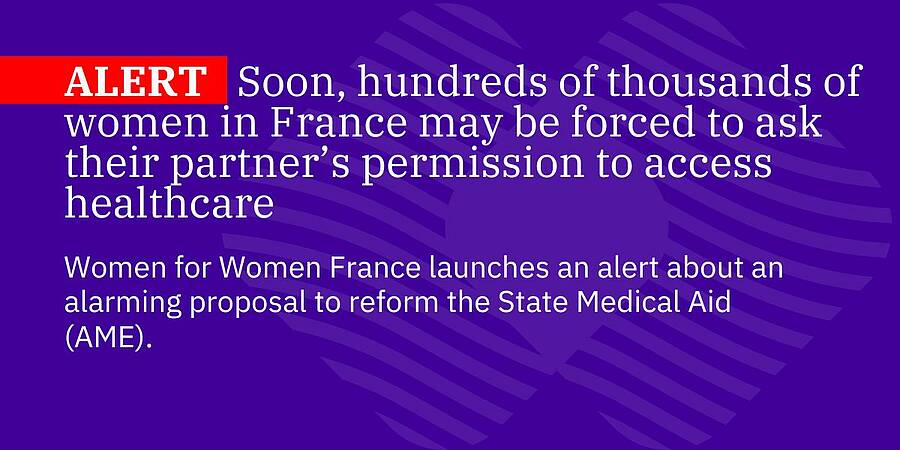
The Delahaye report, published on the French Senate website on 9 July, is alarming. Recommendation No. 5 explicitly proposes to “take into account the partner’s income” when determining eligibility for State Medical Aid (AME). This measure could turn access to healthcare into a tool of domestic abuse against women living in extreme precarity in France.
Women for Women France is sounding the alarm: this proposal will force hundreds of thousands of women in France to obtain their partner’s permission to access medical care. It would also compel tens of thousands of victims of domestic abuse, sexual exploitation, or human trafficking to seek their abuser’s approval to access post-abuse healthcare.
Domestic abuse: how tens of thousands of women become—or remain—undocumented and dependent on State Medical Aid (AME)
State Medical Aid (Aide Médicale de l’État – AME) allows undocumented individuals in France to access healthcare. It protects not only their health, but also public health for everyone living in France.
Foreign-born women in France face significant economic and social disadvantages. This is compounded by administrative insecurity, since immigration status often depends on a woman’s family or marital situation. Women for Women France estimates that approximately 85,000 women in France are undocumented as a direct result of abuse—particularly administrative abuse—within their relationship.
Administrative abuse: a widespread but invisible form of coercive control
Administrative abuse is a form of coercive control that aims to keep a woman undocumented or entirely dependent on her partner. It takes many harmful forms, including:
- Withholding or destroying documents: Partners may hide or destroy proof of language classes, integration courses, or prefecture appointments to block the renewal of residence permits.
- Refusing to provide necessary documents or support: Some partners withhold essential paperwork—such as proof of cohabitation or housing documents—deliberately preventing a woman from regularising her status.
- Forbidding her from learning French: Preventing a woman from enrolling in language or job-readiness courses undermines her ability to meet the legal requirements for a residence permit.
- Controlling access to digital systems: In an increasingly digital environment (ANEF, Ameli, CAF, etc.), partners may block access to online platforms, creating total digital dependency.
- Threats and coercion: Partners may threaten to withdraw their support or report the woman to immigration authorities in order to maintain control through fear of expulsion.
“Although this form of abuse is well documented, it is not recognised under the French Penal Code and remains misunderstood by policymakers. If it’s not in the Penal Code, it’s as if it’s legal in France to commit this, one of the most devastating forms of domestic abuse,” says Alexandra Lachowsky, Advocacy Director at Women for Women France.
For victims of administrative abuse—who are left unprotected by French law—AME is a critical pathway to autonomy and often their only means of accessing healthcare in France.
A policy that enforces dependency and fuels domestic abuse
Under the current system, AME allows a woman without a residence permit, living with someone covered by the French healthcare system (whether a French citizen or a regularised foreign national), to access healthcare regardless of her partner’s income.
If partner income is taken into account, many women would be excluded from this essential service. At the same time, their undocumented status would make them ineligible for public health insurance or complementary solidarity coverage.
The result: thousands of women in France left without any healthcare coverage at all—completely dependent on their partner’s consent to meet their health needs.
“No woman should ever have to ask for money—and therefore, for permission—from her partner to see a doctor. That must be a red line in any reform of the AME,” says Sarah McGrath, Chief Executive Officer of Women for Women France.
Foreign-born women are already disproportionately affected by domestic abuse in France due to the accumulation of vulnerabilities: economic, social, and administrative. They are also subjected to specific forms of coercive control—such as threats related to immigration status, isolation, and obstruction of legal procedures.
Factoring in a partner’s income to determine AME eligibility would only intensify these risks. It would deepen women’s dependency and expose them even more to coercive control and abuse.
“Restricting access to healthcare fits perfectly within known patterns of domestic abuse. By undermining women’s autonomy and their fundamental right to bodily integrity, such a policy would reinforce abuse, increase dependency, and endanger women’s health, safety, and lives,” warns Alexandra Lachowsky.
A measure with devastating consequences for victims of gender-based and sexual abuse
Denying victims of domestic abuse, sexual exploitation, or human trafficking the right to access healthcare independently would have devastating, immediate effects. These women would be forced to ask their abuser’s permission to access post-abuse care.
Limiting access to healthcare professionals and services would also undermine a crucial part of the protection system in France. Fewer medical visits mean fewer chances to identify abuse, report it, and connect women to law enforcement or support services.
“The abuse becomes threefold: the violence itself, the inability to access post-abuse healthcare, and the barrier to safety and justice. We know that medical settings are often the first entry point for survivors into a pathway to protection and legal recourse. At a time when France is preparing to expand the ability to file police reports from within hospitals, this reform would deny women access to hospitals altogether,” says Alexandra Lachowsky.
A policy that enables abusers
Sarah McGrath, Chief Executive Officer of Women for Women France, states:
“This proposal shows that the French government still does not grasp the reality of domestic abuse or coercive control. It has failed to carry out a basic risk assessment regarding women’s safety in developing this policy. When we force a woman to depend on her abuser to access healthcare, we become complicit with her abuser.”
Women for Women France calls on the government to unequivocally reject the inclusion of partner income in AME eligibility. This change would represent a dangerous rollback of the right to health in France and pose a serious threat to women’s safety.
Media
Inquires or interview requests: media@womenforwomenfrance.org
Sign up to our Press Office to receive access to our media statements and comments, as soon as they are issued. WFWF cannot comment on cases currently before the court.
If you are writing about domestic abuse, please consider including resources for victims in your article:
- Emergency services (police, ambulance, fire): 112 (24/7)
- Multilingual Online Resource Centre for victims of domestic abuse and gender-based violence: www.womenforwomenfrance.org (24/7)
- Helpline for victims of domestic abuse and gender-based violence: 3919 (24/7)
Keep up-to-date
Every two months, the Women for Women France newsletter provides information about available resources, new measures, and news concerning domestic abuse, coercive control, and migrants rights in France.
To join our community: register here.
About WFWF
Women for Women France (WFWF) is the creator and manager of the national Online Multilingual Online Resource Centre for all people confronted with domestic abuse and gender-based violence in France. Our expertise is in domestic abuse, coercive control, and migrants’ rights.
WFWF has a team of multi-disciplinary experts in France who monitor current events and laws and provide research-based insights and recommendations.